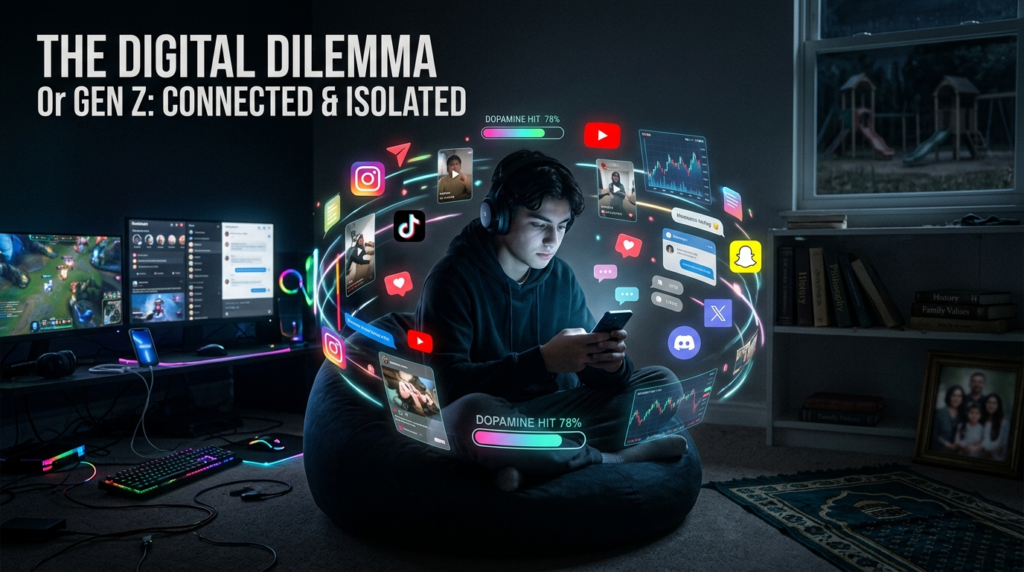
The term Generation Z is no longer confined to academic discussions or sociological research. It has entered everyday conversation. Parents, teachers, psychologists, and social commentators frequently refer to this generation when discussing the future of society. Some describe it as the most intelligent generation of the digital age, while others consider it the most informed and globally aware generation in history. Yet beneath this bright description lies a deeper and more troubling reality—one that is rarely examined with honesty and depth.
Generation Z is the first generation to grow up entirely in the digital ecosystem. For them, the smartphone is not merely a tool; it is an extension of life itself. From the moment they wake up until the moment they fall asleep, screens dominate their attention. Modern neuroscience explains that social media platforms are designed to trigger the release of dopamine, a chemical in the brain associated with pleasure and reward. Every notification, like, comment, or short video creates a small burst of satisfaction. Over time, the brain becomes dependent on these repeated dopamine hits.
This phenomenon is known as the dopamine cycle, and it explains why endless scrolling through short videos or social media feeds becomes addictive. When the mind becomes accustomed to instant gratification, slower and more meaningful activities—reading, studying, reflection, or even meaningful conversations—begin to feel dull and exhausting.
The consequences of this shift are visible in daily life. Many young people now live with a disrupted routine. Late nights spent scrolling through phones, watching short-form videos, gaming, or chatting online are followed by late mornings or even afternoons of sleep. When a person begins the day at noon rather than dawn, discipline slowly erodes. The rhythm of life collapses. Worship, study, work, and responsibility lose their natural place in the day.
Physical health is another silent casualty of this lifestyle. Previous generations spent much of their childhood outdoors—running, playing, competing, and exploring. Today, urban environments provide fewer playgrounds, and digital entertainment provides an easier alternative to physical movement. As a result, many young people suffer from lethargy, poor stamina, irregular sleep patterns, and declining physical strength. A body deprived of movement gradually loses vitality, and with it the resilience that builds strong character.
Yet the crisis of Generation Z is not only physical or behavioural, but it is also moral and psychological. Social media platforms often expose young minds to content that reduces human relationships to superficial entertainment. Repeated exposure to vulgar or explicit material slowly reshapes perception. Respect, modesty, and the sacred boundaries of family relationships begin to blur. When dignity is trivialised and intimacy is commercialised, the moral compass of a young mind can become deeply confused.
This confusion eventually manifests in disturbing social patterns. Newspapers increasingly report stories of young people speaking harshly to their parents, showing little respect for their mothers, or behaving aggressively toward siblings. Such incidents are not merely individual moral failures; they reflect a deeper collapse in the culture of upbringing and moral guidance.
Another growing phenomenon among young people is the obsession with instant wealth. The digital world frequently promotes the illusion that money can be earned quickly and effortlessly. Social media influencers often advertise online trading platforms, forex schemes, investment apps, or gaming systems that promise financial success. For inexperienced young minds, these promises appear irresistible.
Many young people, without proper knowledge or discipline, step into these ventures hoping to become rich overnight. Sometimes the consequences are tragic.
In one such story, a young man became fascinated by online trading after watching videos that glorified quick profits. At first, he borrowed a small amount of money from his father to invest. When losses occurred, he demanded more money. His frustration turned into pressure on the family. Eventually, the savings of the household began to disappear. Jewelry belonging to his mother and sister was sold in the hope of recovering losses. The dream of easy wealth soon turned into financial ruin. Only after everything had been lost did the young man realize the gravity of his mistakes—but by then, the damage had already been done.
Stories like this are no longer rare. They illustrate how impatience, lack of discipline, and digital illusions can lead young people into devastating decisions. Alongside financial risks, another alarming reality is the growing presence of substance abuse and behavioral addictions among some youth. Whether through drugs or digital dependency, the underlying cause remains the same: the search for quick escape and instant pleasure.
Faced with these challenges, the natural question arises: Who bears responsibility for this crisis?
Blaming young people alone is neither fair nor effective. The deeper issue lies in the broader ecosystem of upbringing. Parenting in the modern world has become increasingly complex. Love without boundaries, freedom without guidance, and convenience without discipline can unintentionally weaken a child’s character.
Healthy parenting requires balance. Children need affection, but they also need structure. They need encouragement, but they must also learn responsibility. Establishing routines—such as healthy sleep patterns, controlled screen time, and participation in household responsibilities—helps build discipline and self-awareness.
Parents must also remain attentive to the digital environments shaping their children’s minds. Understanding what children watch, whom they follow, and how they spend their online time is not an invasion of privacy; it is a necessary act of care.
Perhaps most importantly, parents must lead by example. If adults themselves remain constantly absorbed in their phones, children will naturally imitate that behavior. Moral education cannot rely solely on words; it must be reflected in everyday conduct.
Despite the challenges, Generation Z should not be viewed only as a lost or broken generation. In truth, it is a generation full of potential. It possesses creativity, technological fluency, and access to knowledge that previous generations could only imagine. The real challenge is not the technology itself, but how it is used and guided.
If discipline accompanies freedom, if wisdom accompanies information, and if moral character accompanies technological skill, then Generation Z can become one of the most transformative generations in history.
Every societal transformation begins in the same place: the home. When homes cultivate respect, responsibility, patience, and dignity, societies naturally follow suit.
The future of Generation Z—and indeed the future of society—depends on whether we choose comfort over character, or guidance over neglect. The decision, ultimately, rests not with technology, but with the values we pass on to the next generation.