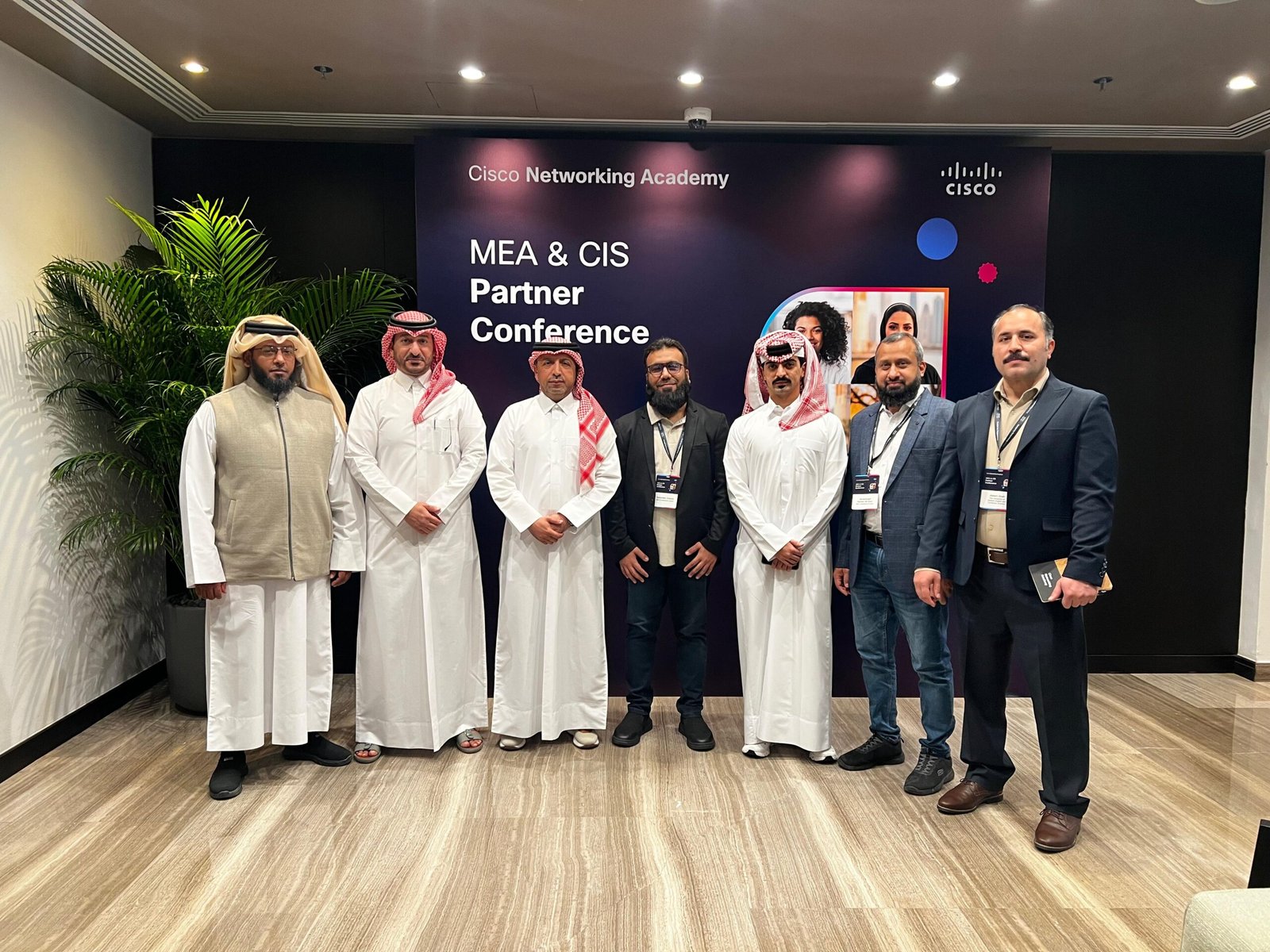
The USECS–Cisco Networking Academy Journey
When I look back at the past few years, one realization stands above everything else: Pakistan does not suffer from a shortage of talent; it suffers from a shortage of direction and opportunity.
Our young people are intelligent. Our teachers are hardworking. Our educational institutions already exist. Yet there remains a serious gap between what many students learn in classrooms and what the modern global economy expects from them.
I have seen this gap closely. Over time, it became increasingly difficult for me to simply talk about it. I felt that if we understood the problem, we also carried a responsibility to become part of the solution.
That conviction eventually became the foundation of our journey with Cisco Networking Academy.
This partnership did not emerge from a single meeting or an accidental opportunity. It developed gradually through nearly two years of conversations, planning, institutional engagement and persistent effort. We asked ourselves a basic question: if the world’s leading economies are being transformed by technology, why should the young people of Khyber Pakhtunkhwa and Balochistan remain on the margins of that transformation?
Artificial Intelligence, cybersecurity, networking, data science, cloud technologies and other digital disciplines are no longer optional areas of knowledge. They are becoming fundamental components of the global economy. Yet in many of our educational institutions, students still have limited exposure to these fields.
We therefore decided that closing this gap required more than another local training programme. It required a direct connection with a global technology education ecosystem.
Taking the Case of Our Region to Dubai
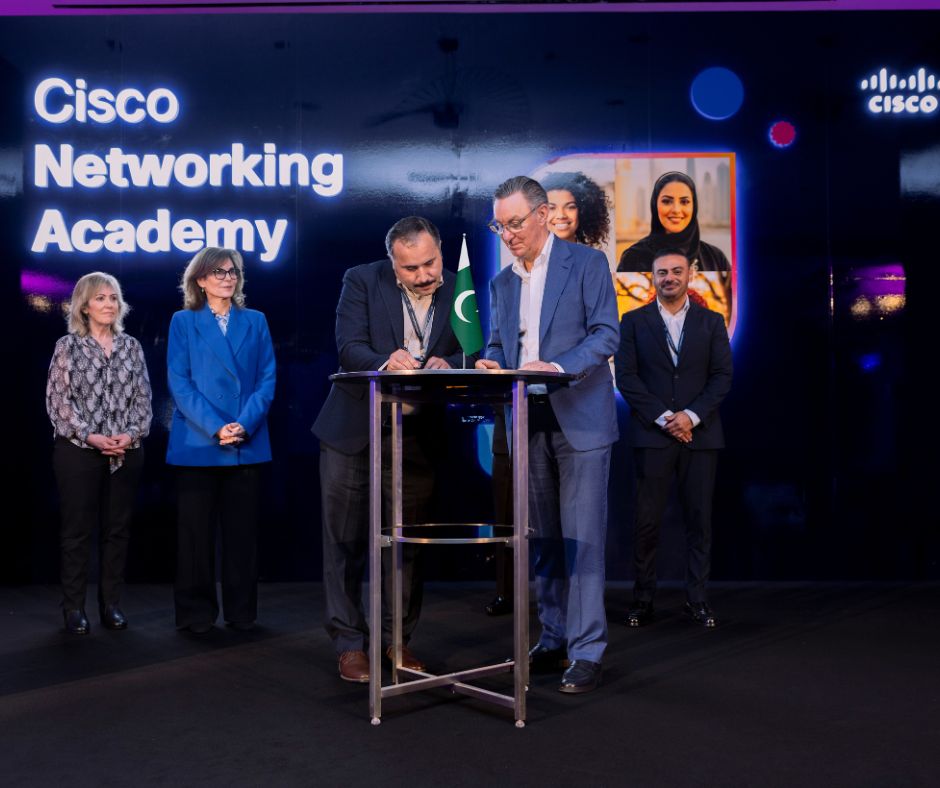
The journey eventually took me to Dubai, where discussions with Cisco leadership provided an opportunity to present the case of Khyber Pakhtunkhwa and Balochistan.
We did not present these regions merely as geographical territories. We presented them for what they truly are: a vast reservoir of young human potential waiting to be developed.
Population figures, the size of the youth demographic, educational realities and changing labour-market requirements formed part of those discussions. The argument was straightforward: if young people from this region receive internationally aligned training and relevant digital skills, they can become productive not only for their own communities and Pakistan, but also for the wider global economy.
Those conversations eventually led to an important milestone: USECS became part of the Cisco Networking Academy ecosystem and took on a support role for institutions in Khyber Pakhtunkhwa and Balochistan.
For me, this was never simply a title or an institutional achievement.
It was a responsibility.
The real test would not be what we signed in Dubai. The real test would be what happened after we returned to Pakistan.
Bringing Educational Leaders Together
Our next challenge was local—and in many respects even more difficult.
International technology opportunities cannot transform a region unless local educational institutions understand them, trust them and develop the capacity to deliver them.
We therefore began reaching out to school leaders, college administrators, educators and institutional owners across Khyber Pakhtunkhwa.
This effort culminated in a major gathering at Serena Hotel, Peshawar, where educational leaders were brought together to understand the changing global skills landscape and the opportunity presented by Cisco Networking Academy.
A significant number of institutions entered into MoUs and began a journey that was designed to move beyond signatures and ceremonies.
The objective was clear: train the institutions first so that they can train the next generation.
Why We Started With Teachers and Principals
One principle has guided this initiative from the beginning: sustainable educational transformation cannot be built by bypassing teachers.
Change must enter the institution itself.
That is why principals, instructors and educators were encouraged to become learners again. They began completing courses in areas including Artificial Intelligence and other modern technologies, gaining practical exposure and relevant credentials before taking this knowledge to their students.
This approach changes the relationship between teacher and technology.
A principal who has personally experienced modern digital learning can lead differently. A teacher who has completed the training can stand before students with practical confidence rather than simply repeating theory.
The mathematics of this model is powerful.
Train 100 educators well, and they can influence 1,000 students. Train institutions rather than individuals alone, and the impact can continue year after year.
This multiplier effect is at the heart of what we are trying to build.
Four Months That Turned Agreements Into Capacity
After institutional mobilisation came the harder phase: training.
For approximately four months, participating educators and institutional representatives worked through structured learning and development. Internationally aligned coursework, instructor development, technical learning and continuous support began turning the original MoUs into practical institutional capability.
This is an important distinction.
Signing an agreement takes a few minutes.
Developing a capable instructor takes time.
Building a sustainable learning environment takes even longer.
That is why the months between our major events were perhaps more important than the events themselves. Away from stages and cameras, teachers were learning, institutions were adapting and a support structure was being developed.
The role of Cisco Networking Academy’s team in this process has been invaluable.
Faheem Anwar, whose engagement with Cisco Networking Academy in Pakistan has been central to this journey, deserves particular appreciation. His understanding of the region, his willingness to engage with educational institutions and his continued support helped move the initiative from conversation towards implementation.
Our trainers and instructors also carried a demanding responsibility. Karim Abeed, from Egypt, contributed to the training process, alongside the instructors, coordinators and teams who invested their time in developing local capacity.
Technology may provide the curriculum and platform, but ultimately it is committed people who transform an opportunity into impact.
A Global Result From Peshawar
One of the encouraging indicators came through our participation in the Cisco Networking Academy Learn-A-Thon.
According to our institutional results, USECS achieved fourth position globally and second position in Pakistan in the relevant competition.
For us, the importance of this achievement went beyond ranking.
It demonstrated something we have believed for years: location does not define intellectual potential.
An institution in Peshawar can participate on a global platform. An instructor from Khyber Pakhtunkhwa can engage with internationally aligned learning. A student from Balochistan can acquire skills relevant to employers thousands of kilometres away.
What matters is access, preparation, discipline and opportunity.
From Serena to the Next Stage
The Serena gathering was therefore not an isolated event. It was one stage in a much longer process.
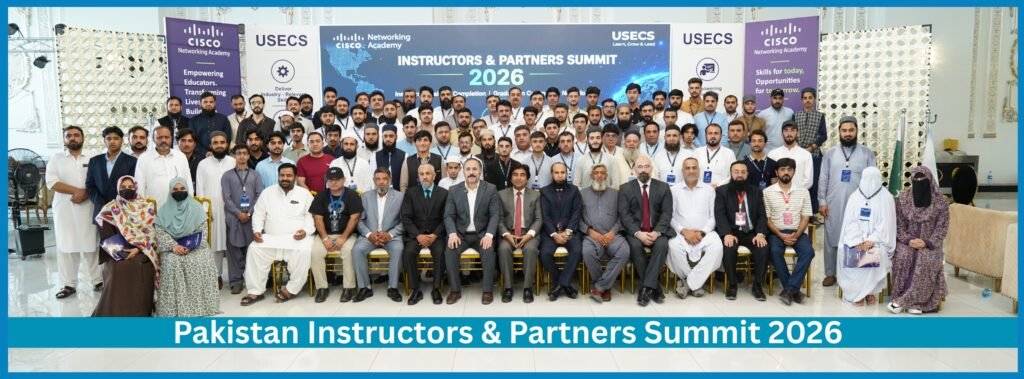
The next major gatherings, including the Pakistan Instructors & Partners Summit 2026, have allowed us to recognise progress, bring partners together again, sign additional MoUs, engage educators and technology professionals, and demonstrate that the original vision is continuing to expand.
These events have included keynote discussions, technical sessions, institutional networking, awards, panel conversations and recognition of instructors and partners.
But behind every photograph from these events lies a sequence that matters far more:
Awareness led to trust.
Trust led to partnership.
Partnership led to training.
Training is now leading to institutional capacity.
And institutional capacity must now lead to student opportunity.
That is the real story.
What Happens Next?
After Eid, the next phase of this journey has already begun with greater ambition.
There are still educational institutions that could not participate in the earlier programme. Some did not have the opportunity; others were not ready at the time; and some have yet to enter into a formal partnership.
We now intend to bring many of these institutions together through another organised summit.
Schools, colleges, principals, teachers and institutional leaders will be invited to understand the programme, evaluate the opportunity and, where appropriate, become part of this growing skills ecosystem.
However, bringing institutions together will only be the beginning.
Training will remain the decisive stage.
Our focus will be on comprehensive instructor development, continuous institutional guidance, practical transfer of skills and sustained support. The objective is not simply to help an institution launch a course and then leave it on its own.
We want participating institutions to develop systems capable of maintaining quality.
That requires patience.
It requires monitoring.
And it requires commitment from both the support structure and the participating institutions.
From Students to Globally Competitive Professionals
The ultimate measure of this initiative will never be the number of MoUs we sign.
It will be what happens to the students.
Our ambition is that a young person should emerge from this ecosystem with a combination of internationally relevant learning, practical digital competence, communication ability and professional discipline.
A certificate by itself does not guarantee a job in America, Canada, Europe, the Gulf or anywhere else. Nor should we ever make such a promise.
But a young professional who possesses strong technical skills, credible training, relevant credentials, English communication ability and professional behaviour enters the labour market from an entirely different position.
Instead of competing only for low-skilled work, that person can compete for skilled professional opportunities.
Instead of asking the world merely for employment, our youth should increasingly be able to offer the world expertise.
And when expertise becomes valuable enough, geography begins to matter less.
A young Pakistani may work locally for an international organisation, contribute remotely to global projects, establish a technology business, enter international employment or compete for opportunities in markets where highly skilled professionals can command significant incomes.
That is the economic dimension of this educational journey.
Why This Matters Beyond Education
When one young person becomes economically productive, one life changes.
When thousands acquire valuable skills, the economics of communities begin to change.
And when institutions themselves develop the capacity to produce skilled people continuously, the transformation can become generational.
This is why I do not see digital education merely as an academic project.
It is connected to employment.
It is connected to dignity.
It is connected to poverty reduction.
It is connected to economic mobility.
And it is connected to Pakistan’s ability to convert its enormous youth population into genuine human capital.
These goals also align naturally with broader global priorities around quality education, decent work, innovation and poverty reduction represented in the United Nations Sustainable Development Goals.
We should, however, remain realistic. No single institution, partnership or technology programme can solve Pakistan’s economic challenges.
But it can create a model.
And a successful model can be multiplied.
A Message to Our Partners at Cisco
For our colleagues and leadership across Cisco and Cisco Networking Academy, the most important message from Khyber Pakhtunkhwa is simple:
The opportunity entrusted to this region is moving on the ground.
Educational institutions have been mobilised.
MoUs have progressed into training.
Principals and instructors have participated in technology learning.
New institutional partnerships are being developed.
Summits have created wider awareness.
International learning initiatives have produced encouraging results.
And the next phase is designed to bring even more institutions into the ecosystem.
There is still a long way to go. Quality must be protected. Training must continue. Institutions must remain active. Students must ultimately demonstrate outcomes in education, employment and entrepreneurship.
But the foundation is becoming stronger.
For this, I remain deeply grateful to Cisco Networking Academy, its leadership and everyone who has supported this journey.
I particularly acknowledge the contribution of Faheem Anwar and the Cisco team whose engagement has helped translate an ambitious idea into an expanding regional initiative. I also thank our trainers, instructors, institutional heads and every educator who accepted the challenge of learning something new so that their students could inherit something better.
The Real Journey Begins in the Classroom
There will be more events.
There will be more MoUs.
There will be more photographs, certificates and ceremonies.
But none of these will ultimately define our success.
Our success will be defined by what happens when an instructor returns from training and stands in front of twenty, fifty or one hundred students.
It will be defined when a student in Peshawar, Swat, Mardan, Charsadda, the tribal districts, Quetta or another underserved community discovers Artificial Intelligence, cybersecurity or networking not as a distant concept, but as a field in which he or she can build a future.
It will be defined when an employer chooses one of these young people because that student possesses the skills the market actually needs.
And it will be defined when families begin to see that world-class opportunity does not always require leaving one’s homeland without preparation; sometimes it begins by bringing world-class learning closer to home.
That is the future we are working towards.
The last two years were spent building relationships, earning trust and creating a structure.
The coming years must be about scale, quality and measurable impact.
If we remain disciplined, sincere and consistent, I believe the day will come when Khyber Pakhtunkhwa and Balochistan will no longer be discussed only in terms of the challenges they face.
They will also be recognised for the human capital they produce.
And when our young people stand confidently in the global marketplace—skilled, certified, articulate and professional—their success will belong not to one institution or one individual, but to every teacher, partner and organisation that chose to believe in their potential before the rest of the world could see it.
That is the journey we began. And, in many ways, it has only just started.